
SRF'S MODEL FOR RESEARCH HUMAN RESOURCE DEVELOPMENT
Soar Research Foundation aims at inspiring, supporting and mentoring of researchers towards research excellence. We have developed and utilize a mentorship approach as we administer all our services. This approach is guided by our SRF model for research human resource development, which has 7 core components.
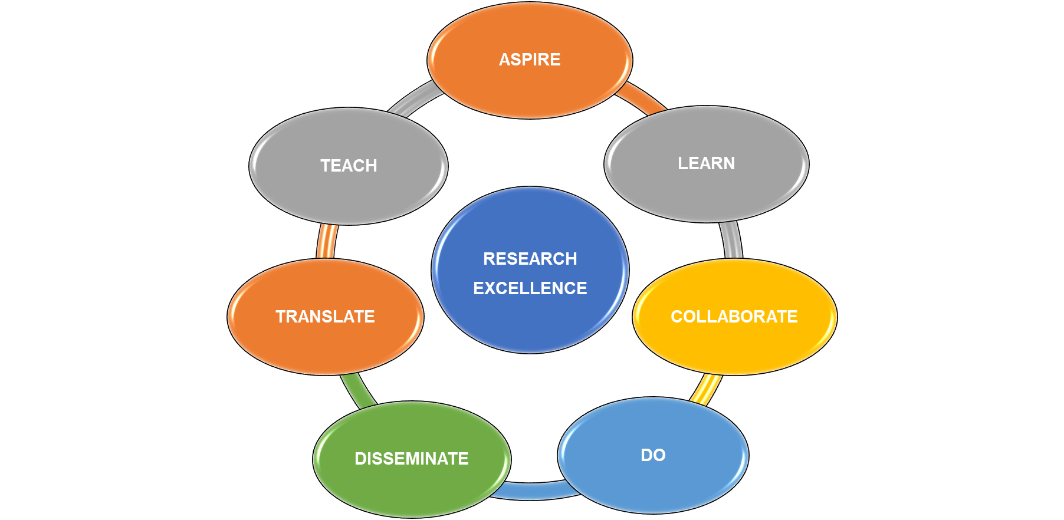
1) ASPIRE: We believe that for whatever level of research excellence one desires to attain, it all starts with having an Aspiration. So, we always inspire our clients so that they can aspire to higher levels of research excellence. We know that a person’s aspirations will always be the motivation for them to work hard and to prioritize the development of their research career.
2) LEARN: One must receive research training and mentorship to receive the skills and knowledge that can enable them to achieve their aspirations. We therefore encourage researcher to invest in themselves by enrolling in our research training program.
3) COLLABORATE: Being a researcher in settings that suffer limited experienced human resource and infrastructure for research, it is almost unavoidable for one to collaborate with other researchers and organizations to achieve their goals. Collaboration could be needed at any stage of the research project life cycle. We therefore offer collaboration opportunities between researchers and SRF and offer training on responsible research collaborations in global health.
4) DO: We appreciate that much of the research experience one can attain must come through actively doing research. There are many skills and tacit knowledge one acquires in this process. SRF offers opportunities to aspiring researchers to initiate new research projects through SRF or within a collaborative framework and continue to mentor them and ensure methodological quality through this research process.
5) DISSEMINATE: We emphasize that research should be tailored towards addressing societal problems and to improve human survival and wellbeing. Research outputs are and should be to the benefit of the public which include other researchers that would desire to use the evidence to further knowledge. Publications are also a core research output that would result in increased recognition of a researcher, publicity of an institution and global competitiveness of Africa regarding contribution to knowledge. At SRF we mentor researchers in written (manuscript writing), oral, audiovisual, large scale science communication, community, and other stakeholder engagements. We support in organizing dissemination conferences, develop dissemination materials, and evaluating new & innovative models of dissemination of research outputs to local communities.
6) TRANSLATE: We emphasize that a researcher must work to see how to translate the findings of their research into policies, interventions, technologies, or guidelines that can address community problems at a large scale and in a more definitive way. In as much as this may go beyond the ability of an individual researcher, but they could still collaborate engage stakeholders. This translation can at times yield economic benefits to the researcher, their institution and country. SRF offers training in this regard and works within its partnerships to support research translation.
7) TEACH: We encourage that every researcher that has gone through the steps within the pathway to research excellence should engage in knowledge sharing activities (teaching and mentorship) to support efforts of raising more skilled researchers in resource limited settings. Such researchers are normally encouraged to offer trainings, consultancy, and research forums within SRF.
Beyond this stage, a researcher can still be inspired to pursue an even higher level of research excellence and may inevitably have to follow through the same steps above.